
As communication challenges become more complex, from misinformation to stakeholder activism, the need for well-trained, strategically minded communication professionals will continue to grow.
The public relations profession is evolving at an unprecedented pace. Digital transformation, rapid information flows, and increasingly complex stakeholder environments have fundamentally reshaped how organisations communicate.
In such a landscape, professional learning can no longer rely solely on traditional academic programmes.
This is where micro-credential programmes are becoming increasingly important. They provide a flexible pathway for professionals, students and organisations to acquire specialised competencies that are closely aligned with real-world industry needs.
Recognising this shift, White & Associates Founder, Abdul Latiff Puteh, was invited in the third quarter of 2025 to collaborate with the Faculty of Languages and Communication, Universiti Sultan Zainal Abidin (UniSZA) to co-develop modules for the faculty’s Micro-Credential Programme in communication.
This collaboration reflects White & Associates’ broader commitment to supporting the development of professional communication standards in Malaysia.
Bringing Industry Experience into Professional Learning
Public relations is a profession that cannot be learned through theory alone. While academic frameworks provide essential foundations, effective communication practice often depends on experience gained through real-world situations; managing crises, navigating stakeholder expectations, crafting persuasive narratives and representing organisations in high-pressure environments.
Drawing on more than three decades of experience in strategic communication, Abdul Latiff contributed three modules to the programme:
- Introduction to Crisis Communication
- Crafting Key Messages
- Spokesperson Training
These modules address competencies that are increasingly critical for communication professionals operating in today’s highly visible and rapidly evolving media environment. The modules were completed and submitted at the end of 2025.
Crisis Communication: A Critical Competency
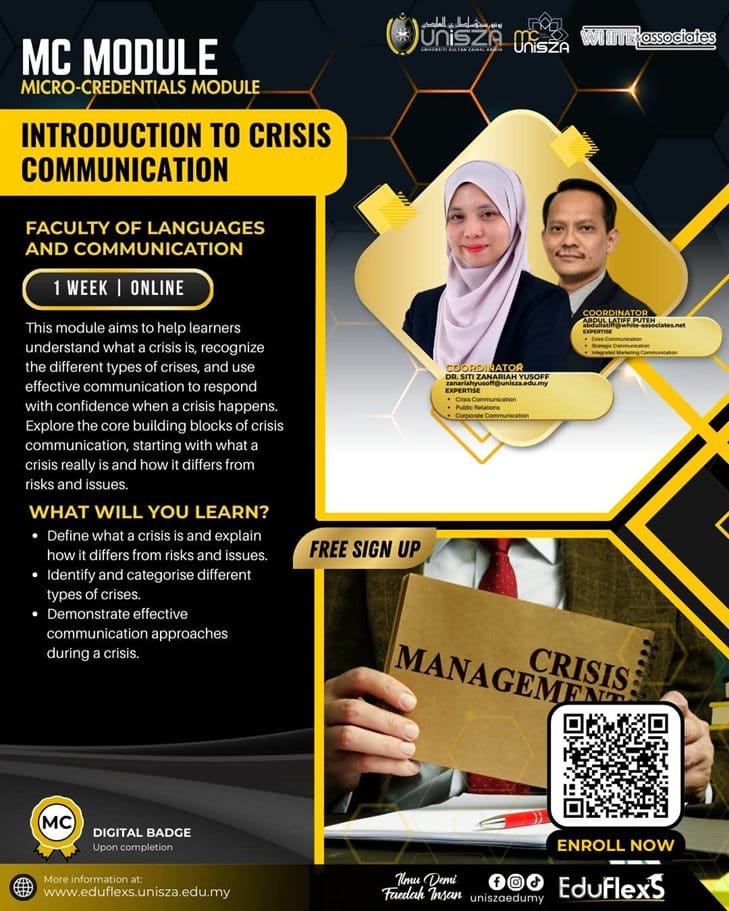
One of the key modules developed for the programme is Introduction to Crisis Communication, designed to equip participants with the foundational principles required to understand and respond effectively during crises.
The course introduces participants to key concepts such as defining what constitutes a crisis, distinguishing crises from risks and issues, identifying different types of crises, and applying effective communication approaches when responding to high-pressure situations.
In today’s interconnected media environment, organisations are often judged not only by the crises they encounter but also by how effectively they communicate during those crises. Reputation can be strengthened or severely damaged within hours.
For this reason, crisis communication has become one of the most critical strategic competencies in modern public relations practice.
Crafting Key Messages and Developing Credible Spokespersons
Beyond crisis communication, the modules also emphasise two essential communication capabilities that are central to effective organisational communication.
Crafting Key Messages
In an environment where information travels rapidly across multiple platforms, organisations must communicate with clarity, consistency and credibility. Carefully developed key messages enable organisations to maintain control of their narrative while addressing stakeholder concerns effectively.
Spokesperson Training
During periods of organisational scrutiny, spokespersons become the public face of an institution. Their ability to communicate with confidence, accuracy and authenticity plays a crucial role in maintaining public trust.
Professional spokesperson training therefore remains an essential component of modern strategic communication practice.
Participants enrolled in these micro-credential modules gain exposure to practical knowledge and skills that strengthen their readiness to manage communication challenges and respond effectively during crises.
Recognition of Collaboration
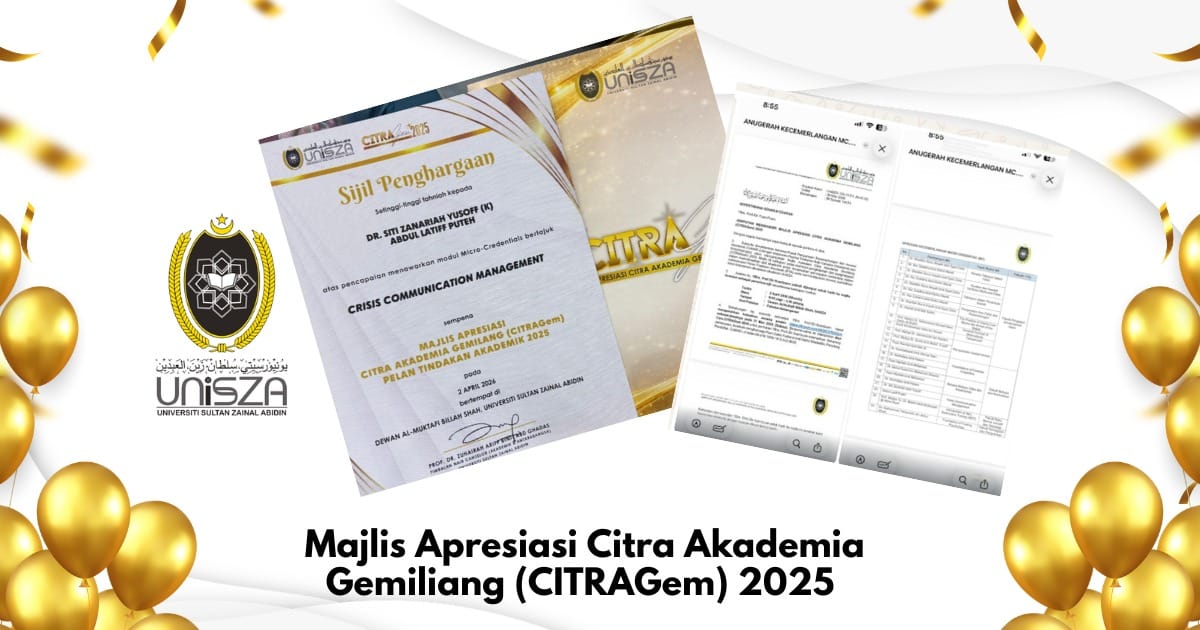
In recognition of this contribution to the programme, Abdul Latiff Puteh was jointly presented with an Appreciation Award, together with Dr Siti Zanariah Yusoff, the coordinator of the UniSZA Micro-Credential Programme.
While such recognition is appreciated, the broader significance lies in the collaboration itself. Partnerships between universities and industry practitioners create opportunities for academic programmes to remain aligned with professional realities.
For students and participants, this means learning not only theoretical frameworks but also practical insights drawn from real-world communication challenges.
The Role of Practitioners in Shaping the Profession
At White & Associates, we believe that experienced practitioners have an important role to play in shaping the future of the communication profession.
This responsibility extends beyond consultancy and corporate advisory work. It also includes contributing to:
- Professional education
- Industry dialogue
- Ethical standards in communication practice
- The development of future communication professionals
As communication challenges become more complex, from misinformation to stakeholder activism, the need for well-trained, strategically minded communication professionals will continue to grow.
Advancing Professional Standards in Malaysia
Malaysia’s communication industry has matured significantly over the past three decades. However, continued progress requires strong collaboration between industry practitioners, universities, professional associations and policy institutions.
Micro-credential programmes represent one promising approach to strengthening this ecosystem.
They enable practitioners to share specialised knowledge, allow universities to update their curricula more rapidly, and provide learners with targeted competencies that respond to the evolving communication environment.
White & Associates remains committed to supporting initiatives that strengthen professional excellence, ethical practice and strategic communication capability in Malaysia.
Collaborations such as the UniSZA Micro-Credential Programme represent an important step in that direction. We view such initiatives not simply as academic collaborations, but as part of a broader mission, to contribute meaningfully to the development and advancement of the communication profession in Malaysia.
Register your participation in the micro-credentials programme here: https://eduflexs.unisza.edu.my/courses/introduction-to-crisis-communication/?cl=1
#WhiteAndAssociates
#StrategicCommunication
#PublicRelationsLeadership
#IndustryAcademia
#ProfessionalDevelopment
#MicroCredentials
#CommunicationProfession